Everything in Modification (by RAVA-GE)
"Game Log 4 - Creation"
Methods used
For this phase of the project we modified some of the methods presented. We did make a playable prototype, which ended up being more of a first draft of the completed experience. This decision made us a significantly larger amount of time on this method, than any of the other methods.
Although we did not explicitly make an Expo Decision board, we ended up creating a roadmap for finishing the playable prototype. This served a similar purpose of focussing our work and mapping out deadlines.
As we got closer to the Expo we tried to make use of the methods for pitching, plaque and promo video. Due to time pressures we did not follow the methods thoroughly as in earlier phases.
Our process
Roles from the EPIC-WE guide were assigned as follows:
Game master: Mikkel
Artist: Isabella (Paintings) Simon & Naja (3D)
Storyteller: Nadia
Designer: Simon - Assisted by Naja.
Crafter: Mikkel
We decided on creating a roadmap, as many of our objectives were dependent on other activities being completed. The road map gave us an overall perspective on who did what, and which tasks took priority.

Essentially the roadmap took the place of the Expo decision board making prioritizing easier. Later it included more tasks for each member, as we zeroed in on specific assignments that needed to be done. It was also limited by the fact that it was too focused on the creation of our game with little thought being placed on the Expo and elements needed for it.
We are going to split the process into sections of music, narrative, art and programming.
Music
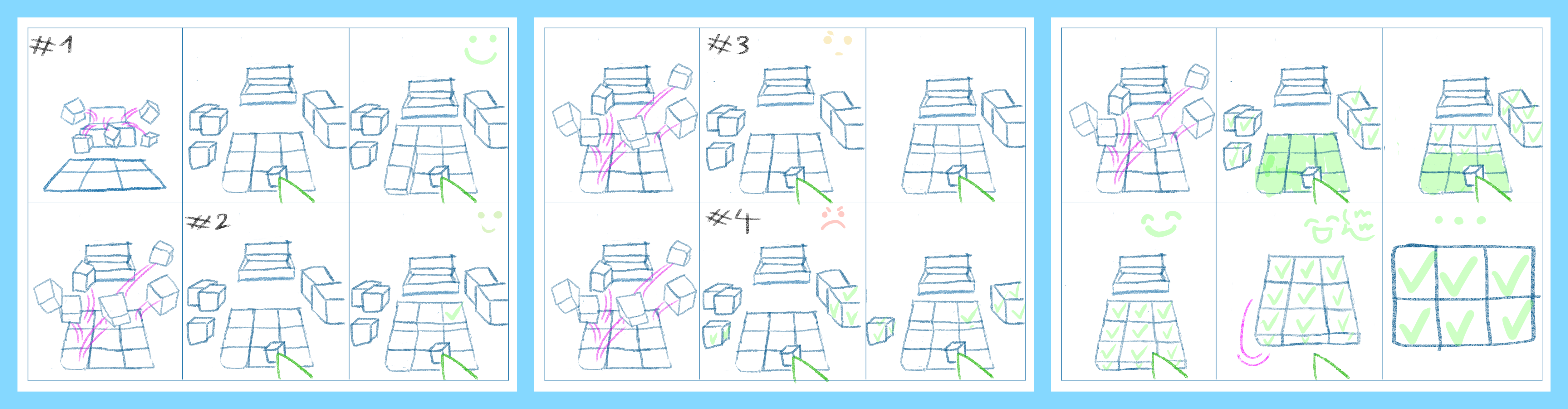
We decided that we wanted to outsource the music and requested the work from an acquaintance, Jeppe Gass. Having to introduce our concept and idea for an uninvolved party required us to refine it. We did this by creating a small storyboard of the interaction flow of the game.
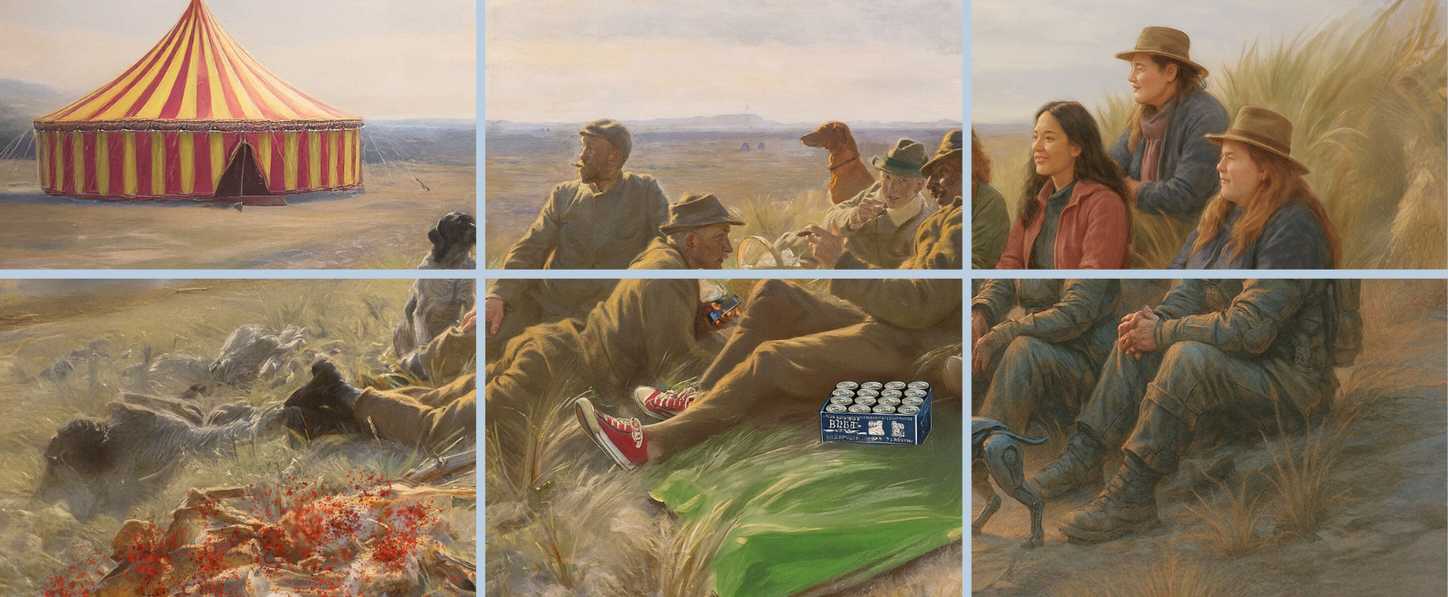
Furthermore describing our vision for the setting and providing a rough mood board.

We ended up receiving a score of around 4 minutes consisting of three tracks, as well as two small jingles to signal the player making a mistake or succeeding in following the orders of our narrator.
Narrative
Following the game play test, we decided to redo parts of the script toning down the themes of propaganda to better fit the artwork we had chosen. We turned our focus on narratives and choosing between them. After the rewrite, we recorded the voice lines. We initially wanted to use more than one voice but decided on one as to not confuse the player too much. Instead we used effects to warp the voice lines.
Art
Due to our limited time we reduced the amount of work needed for modelling by reducing the scope of the environment, this made us create a small workstation, that could easily be copied around to capture the aesthetics of mass production and drone work, that we were aiming for in our mood boards. Despite this, art was our most people intensive project.
On the 2D side we took our chosen artwork, creating multiple alternatives using photoshop and its AI features. This helped us make alternates that both looked different, but retained coherence with the original making it possible to mix between pieces
Programming
On the programming side. We tried to limit what was needed. Mainly focussing on a system that lets players place blocks and then check whether or not the blocks were placed correctly. This was done to limit the amount of narrative we needed to create.
Programming was limited by lack of initial planning, which made methods too interconnected and made bug fixing quite time expensive. Better initial plans and structures of the game’s code would most likely have solved this.
Preparations for Expo
For the expo we decided to create a plaque presenting the concept. We chose to make an engraving in wood, which matched our visual aesthetic of wooden blocks.

The text for the plaque read:
Everything in Modification
By RAVA-GE
This game is what we call a reverse puzzle. The game robs the player of their agency by forcing the solution and chastising the player for not following along. In this, we want to comment on the presence of narratives that are being pushed onto us from all angles and - by evoking emotions such as spite in the player - underscore that we as individuals have the freedom to choose the narratives we believe.
We focused on the work Hunters of Skagen, as P. S. Krøyer chose to depict a somewhat idyllic landscape despite being painted during the modern breakthrough. Our interpretation of art and the role art plays in heritage is that they are narratives that we tell about ourselves, and we want to emphasise that these, like all narratives, are not objective truths.
Posters and ornaments
For the expo space we wanted people to be able to watch the game being played. To reference the game a bit, we placed a stuffed invertable toy (different patterns on each side), which was kind of similar to the ones in our game, accompanied by two wooden blocks. Other than that, there was a laser-printed wooden plaque, as well as a poster with a modified picture of Skagensjægerne and a link to the game page. We did not make a substantial thematic throughline with our expo space.

Results from the Expo
Evaluation plan
The evaluation plan was focused on how the game felt to players and what message they took away from the experience. Participants were encouraged to think aloud while playing, followed by a short conversation and a written reflection on sticky notes for qualitative insight/documentation. This method provided us with a broad range of feedback.
Evaluation Results
Overall, the feedback showed that while players had mixed experiences with the mechanics, the concept was received as engaging and thought-provoking. First-time VR users often struggled with controls, especially rotating and placing the puzzle pieces, which caused some frustration, though most still expressed curiosity and enjoyment. More experienced players navigated the game more smoothly and often completed it.
Many participants reacted strongly when puzzle pieces were removed, leading to moments of confusion or stress, but also prompting reflection. Some even thought it was a mistake. The think-aloud approach revealed a variety of emotional responses, ranging from laughter to frustration. The voiceover was seen as immersive and slightly authoritarian, aligning with the intended message of the game, though fewer players commented on it than we had expected.
The sticky notes gave us short reflections like “easy game controls” or “fun and cool game.” However, these notes didn’t always serve their intended purpose of capturing what players took away from the experience on a deeper level.
Reflections After Evaluation
The execution of our evaluation could have been more structured. We often forgot to remind players to think aloud, fortunately, many did so naturally. The sticky notes also resulted in mostly surface-level comments, likely because our instructions were too vague. In future Expos, we’ll provide clearer guidance to prompt more reflective responses.
Additionally, our setup led to some logistical issues. Players giving feedback were often too close to those currently playing, making the space feel chaotic. A better separation between gameplay and feedback areas would help streamline the experience for both players and evaluators. This is something we plan to improve for future expos!
Leave a comment
Log in with itch.io to leave a comment.